Anesthesia | Eklavya Medical
vaccines
medical_services Main Specialty Domain lock Subscription Required

Anesthesia

Clinical anesthesiology, local and general anesthesia delivery systems, monitoring, and perioperative care.

verified Verified Medical Faculty menu_book 337 Q&A Modules
lock Protected Clinical Document • Pulse App • Screenshots Strictly Prohibited
QUESTION 141 person Asked by .
bookmark_add

Nerve Blocks for Hip and Knee Arthroplasty — FNB, Adductor Canal & PENG Block Describe the anatomy and technique of the femoral nerve block (FNB) and adductor canal block (ACB) [4]. Compare FNB vs ACB for total knee replacement analgesia in terms of motor preservation [3]. Outline the PENG block for hip arthroplasty [3].

description Clinical Response
" Q86 - Nerve Blocks for Hip and Knee Arthroplasty — FNB, Adductor Canal & PENG Block
Q86 · Paper II · 10 MARKS · Long Answer

Nerve Blocks for Hip and Knee Arthroplasty — FNB, Adductor Canal & PENG Block

Question: Describe the anatomy and technique of the femoral nerve block (FNB) and adductor canal block (ACB) [4]. Compare FNB vs ACB for total knee replacement analgesia in terms of motor preservation [3]. Outline the PENG block for hip arthroplasty [3].
Core ConceptRegional anaesthesia provides superior analgesia to opioids and enables early mobilisation after arthroplasty. The shift from FNB to ACB (equal analgesia, preserved motor function) represents evidence-based evolution of practice.

A. FNB & ACB — Anatomy & Technique4 marks

  • FNB: femoral nerve lies lateral to femoral artery (NAVEL) below inguinal ligament; USG probe at inguinal crease; inject 15–20 mL LA lateral to nerve.
  • ACB: adductor canal (mid-thigh) bounded by vastus medialis, adductors, sartorius (""roof""); contains femoral vessels + saphenous nerve (purely sensory beyond canal). Quadriceps motor branches leave PROXIMAL to canal – ACB spares motor function. USG probe mid-thigh 15 cm below inguinal crease; ""headphone sign"" (sartorius over vessels); inject 15–20 mL LA.

B. FNB vs ACB for TKR3 marks

FeatureFNBACB
AnalgesiaExcellent anterior knee pain reliefEquivalent (non-inferior in RCTs/meta-analyses)
Motor blockSignificant quadriceps weaknessPreserved quadriceps function
Falls risk↑SignificantlySignificantly reduced
RecommendationLargely replacedPROSPECT 2020 – preferred for TKR

C. PENG Block for Hip Arthroplasty3 marks

  • Anatomy: hip capsule innervated by articular branches of femoral, obturator, accessory obturator nerves coursing between AIIS and iliopubic eminence (pericapsular plane).
  • Technique: low-frequency curvilinear probe at ASIS; inject 20 mL LA between psoas tendon and pubic bone.
  • Advantage: motor-sparing analgesia – preserves hip abductor/quadriceps function → safe early ambulation; superior to FNB for THA.
Examiner's PearlAdductor canal: sartorius = roof; motor branches leave PROXIMAL to canal → ACB = motor-sparing, preferred over FNB for TKR (↓falls, early mobilisation). PENG: targets articular branches of femoral+obturator nerves in pericapsular plane (AIIS–IPE) → motor-sparing hip analgesia, preferred for THA.
References: Jaeger P et al. Anaesthesiology 2013;118:409-415. Girón-Arango L et al. Reg Anesth Pain Med 2018;43:859-863. PROSPECT Guidelines TKR 2020.
"
lock Protected Clinical Document • Pulse App • Screenshots Strictly Prohibited
QUESTION 142 person Asked by .
bookmark_add

Ventilator-Associated Pneumonia — Risk Factors, Prevention Bundle, CPIS & De-escalation Define ventilator-associated pneumonia (VAP) and describe the pathogenesis of microaspiration [3]. Outline the VAP prevention bundle components and the evidence for each [4]. Describe the diagnostic approach using CPIS and principles of antibiotic de-escalation [3].

description Clinical Response
" Q87 - Ventilator-Associated Pneumonia — Risk Factors, Prevention Bundle, CPIS & De-escalation
Q87 · Paper II · 10 MARKS · Short Notes

Ventilator-Associated Pneumonia — Risk Factors, Prevention Bundle, CPIS & De-escalation

Question: Define ventilator-associated pneumonia (VAP) and describe the pathogenesis of microaspiration [3]. Outline the VAP prevention bundle components and the evidence for each [4]. Describe the diagnostic approach using CPIS and principles of antibiotic de-escalation [3].
Core ConceptVAP is the commonest healthcare-associated ICU infection, affecting 9–27% of ventilated patients. It is predominantly preventable – bundle compliance reduces incidence by 50–70%.

A. Definition, Pathogenesis & Risk Factors3 marks

  • Definition: new pneumonia >48h after mechanical ventilation. Early-onset (<5 days): community organisms. Late-onset (≥5 days): MDR hospital organisms.
  • Pathogenesis: oropharyngeal colonisation → secretions pool above ETT cuff → microaspiration <1 mL past cuff → bacterial inoculation → pneumonia; also ETT biofilm dislodgement.
  • Risk factors: supine position, prolonged ventilation >7 days, NG tube, sedation+NMB, reintubation, prior antibiotics.

B. VAP Prevention Bundle4 marks

ElementEvidence
Head of bed 30–45°Drakulovic 1999: 8-fold ↓VAP
Chlorhexidine 0.12% oral care↓VAP incidence (OR 0.67); 2% associated with ↑mortality – use 0.12%
Subglottic secretion drainageMost effective single intervention – ↓VAP 45–50%
Daily SAT + SBTGirard 2008 (ABC trial): 3 fewer ventilator days, ↓1-yr mortality
Hand hygieneMost effective infection control measure – WHO 5 moments
Ventilator circuit careChange only when soiled; HME preferred over heated humidifier

C. CPIS Diagnosis & De-escalation3 marks

  • CPIS: 6 components (temp, WBC, secretions, oxygenation, CXR infiltrates, culture) each 0–2, total 0–12; CPIS ≥6 = likely VAP. BAL with quantitative culture (≥10⁴ CFU/mL) is gold standard.
  • De-escalation: initial broad-spectrum empirical therapy → narrow at 24–48h per culture → stop at 7–8 days if improving (Chastre JAMA 2003: 8 = 15 days for non-Pseudomonas); procalcitonin can guide stopping.
Examiner's PearlVAP pathogenesis: microaspiration above ETT cuff. Most effective prevention: subglottic secretion drainage (↓45–50%). CHX 0.12% (not 2%). CPIS ≥6 = likely VAP. Antibiotic de-escalation: 7–8 days (not 15) for non-Pseudomonas VAP.
References: Chastre J, Fagon JY. Am J Respir Crit Care Med 2002;165:867-903. Chastre J et al. JAMA 2003;290:2588-2598. Klompas M. NEJM 2013;368:1472-1475.
"
lock Protected Clinical Document • Pulse App • Screenshots Strictly Prohibited
QUESTION 143 person Asked by .
bookmark_add

Jehovah's Witness — Legal Framework, Blood Conservation &amp; Autologous Transfusion Describe the legal and ethical framework governing blood product refusal in Jehovah's Witness patients [3]. Outline the pre-operative blood conservation strategies for a competent JW adult [4]. Discuss intraoperative autologous techniques including cell salvage [3].

collections Question Diagrams & Reference Images (1)
Question Reference Diagram
zoom_in View Image
description Clinical Response
" Q88 - Jehovah's Witness — Legal Framework, Blood Conservation & Autologous Transfusion
Q88 · Paper II · 10 MARKS · Long Answer

Jehovah's Witness — Legal Framework, Blood Conservation & Autologous Transfusion

Question: Describe the legal and ethical framework governing blood product refusal in Jehovah's Witness patients [3]. Outline the pre-operative blood conservation strategies for a competent JW adult [4]. Discuss intraoperative autologous techniques including cell salvage [3].
Core ConceptA competent adult's informed refusal of blood transfusion is legally and ethically absolute, even if refusal results in death. The anaesthetist must respect this while deploying all available blood conservation strategies.

A. Legal & Ethical Framework3 marks

  • Competent adult: absolute right to refuse under the Mental Capacity Act 2005, even if fatal; treating against will = battery.
  • ADRT: must be written, signed, witnessed, specific – anaesthetist must comply.
  • Products refused vary individually – document EXPLICITLY what is accepted/refused (many accept cell salvage, fractionated products).
  • Children: parental refusal is NOT absolute – court can override to save the child's life; treat in emergency, seek court order.

B. Pre-operative Blood Conservation4 marks

StrategyDetail
Erythropoiesis stimulationEPO + IV iron 4–6 wk pre-op; target Hb ≥130–140 g/L
Treat underlying anaemiaIDA, B12/folate deficiency, CKD anaemia
Stop anticoagulants/antiplateletsAspirin/clopidogrel 7d, warfarin 5d pre-op
Meticulous surgical techniqueMinimally invasive surgery, careful haemostasis

C. Intraoperative Autologous Techniques3 marks

  • Cell salvage: closed-circuit – blood never leaves the body – most JWs accept; ↓allogeneic transfusion 39%; CI: malignancy in field (debated), bacteraemia.
  • Acute normovolaemic haemodilution: blood removed pre-op (closed circuit), diluted with crystalloid, retransfused at end.
  • Tranexamic acid: ↓blood loss 25–35%; give 1g pre-incision + 1g over 8h.
  • Permissive anaemia: tolerate Hb 50–60 g/L if normovolaemic + 100% O₂.
Examiner's PearlCompetent adult refusal = absolute right (MCA 2005). Children: court can override. Most JWs accept cell salvage (closed circuit) and fractionated products. Pre-op: EPO+iron 4–6wk. Intra-op: cell salvage + TXA + ANH. Aprotinin withdrawn (BART trial ↑mortality).
References: Mental Capacity Act 2005. AAGBI 2005. NICE IPG144. Ker K et al. Lancet 2012;379:1096-1097.
"
lock Protected Clinical Document • Pulse App • Screenshots Strictly Prohibited
QUESTION 144 person Asked by .
bookmark_add

Classification of Shock — Haemodynamic Profiles, ATLS Classes &amp; Goal-Directed Therapy Classify shock into four types with haemodynamic profiles for each [3]. Describe the physiological response to progressive haemorrhage (Classes I&ndash;IV) [4]. Outline the goal-directed resuscitation strategy for each shock type [3].

description Clinical Response
" Q89 - Classification of Shock — Haemodynamic Profiles, ATLS Classes & Goal-Directed Therapy
Q89 · Paper II · 10 MARKS · Long Answer

Classification of Shock — Haemodynamic Profiles, ATLS Classes & Goal-Directed Therapy

Question: Classify shock into four types with haemodynamic profiles for each [3]. Describe the physiological response to progressive haemorrhage (Classes I–IV) [4]. Outline the goal-directed resuscitation strategy for each shock type [3].
Core ConceptShock is inadequate tissue O₂ delivery relative to demand. The four types share this final pathway but differ in mechanism and haemodynamic signature – recognition determines treatment.

A. Shock Classification3 marks

TypeCOSVRPAWP/CVPExamples
Hypovolaemic↓↓Haemorrhage, burns, GI loss
Distributive↓↓Low-normalSeptic, anaphylactic, neurogenic
Cardiogenic↓↓↑↑↑↑MI, acute LV failure
Obstructive↑ (right-sided)Massive PE, tamponade, tension PTX

B. Response to Haemorrhage (ATLS I-IV)4 marks

ClassBlood LossHRSBPMental Status
I<750 mL / <15%<100NormalSlightly anxious
II750–1500 mL / 15–30%100–120NormalMildly anxious
III1500–2000 mL / 30–40%120–140Confused
IV>2000 mL / >40%>140↓↓Lethargic/unconscious

Pulse pressure narrows BEFORE SBP falls (earliest sign). Compensatory: baroreceptor ↑sympathetic, RAAS, ADH, transcapillary refill.

C. Goal-Directed Resuscitation3 marks

TypeFirst-lineAvoid
HypovolaemicControl haemorrhage; 1:1:1 RBC:FFP:Plt + TXA; permissive hypotension SBP 80–90Excessive crystalloid
Distributive (septic)Antibiotics <1h, 30 mL/kg crystalloid, noradrenaline if MAP<65Delayed antibiotics
CardiogenicDobutamine, IABP, revascularisationExcessive fluid
ObstructiveRemove obstruction (needle decompression, pericardiocentesis, thrombolysis)Vasodilators, fluid overload
Examiner's PearlHypovolaemic (↓CO,↑SVR,↓PAWP); Distributive (↑CO,↓↓SVR); Cardiogenic (↓↓CO,↑↑SVR,↑↑PAWP); Obstructive (↓CO,↑right-sided pressures). ATLS Class II: pulse pressure narrows before SBP falls. Permissive hypotension SBP 80–90 until haemostasis.
References: ATLS 10th Ed. Vincent JL, De Backer D. NEJM 2013;369:1726-1734. Surviving Sepsis Campaign 2021.
"
lock Protected Clinical Document • Pulse App • Screenshots Strictly Prohibited
QUESTION 145 person Asked by .
bookmark_add

Acid-Base Physiology — Henderson-Hasselbalch, Stewart's SID &amp; Compensation Rules Explain the Henderson-Hasselbalch equation and its clinical application in acid-base interpretation [3]. Describe Stewart's strong ion approach and the concept of SID [3]. Apply systematic acid-base interpretation with compensation rules to four clinical scenarios [4].

description Clinical Response
" Q90 - Acid-Base Physiology — Henderson-Hasselbalch, Stewart's SID & Compensation Rules
Q90 · Paper II · 10 MARKS · Long Answer

Acid-Base Physiology — Henderson-Hasselbalch, Stewart's SID & Compensation Rules

Question: Explain the Henderson-Hasselbalch equation and its clinical application in acid-base interpretation [3]. Describe Stewart's strong ion approach and the concept of SID [3]. Apply systematic acid-base interpretation with compensation rules to four clinical scenarios [4].
Core ConceptAcid-base disturbances are ubiquitous in anaesthesia and critical care. The Boston approach (Henderson-Hasselbalch + compensation rules) is bedside standard; Stewart's physicochemical approach gives deeper mechanistic insight.

A. Henderson-Hasselbalch Equation3 marks

  • pH = pKa + log([HCO₃&supminus;]/[0.03×PaCO₂]); normal pH 7.35–7.45, PaCO₂ 35–45, HCO₃&supminus; 22–26.
  • Highlights metabolic (HCO₃&supminus; – renal) vs respiratory (PaCO₂ – lung) components; compensation ≠ correction.
  • Anion gap: Na⁺ − (Cl&supminus; + HCO₃&supminus;), normal 8–12. High AG (MUDPILES); normal AG (HARD-UP).

B. Stewart's Strong Ion Approach3 marks

  • H⁺ and HCO₃&supminus; are DEPENDENT variables; pH determined by SID, Atot, and PaCO₂.
  • SID = (Na⁺+K⁺+Ca²⁺+Mg²⁺) − (Cl&supminus;+lactate&supminus;); ↓SID (e.g. ↑Cl&supminus; from saline) → acidosis without invoking bicarbonate.
  • Explains hyperchloraemic acidosis from 0.9% saline; hypoalbuminaemia causes apparent alkalosis (correct AG: +2.5 mEq/L per 10 g/L ↓albumin).

C. Compensation Rules & Scenarios4 marks

Primary DisorderExpected Compensation
Metabolic acidosisPaCO₂ = 1.5×HCO₃ + 8 ±2 (Winters)
Metabolic alkalosisPaCO₂ = 0.7×HCO₃ + 21 ±2
Respiratory acidosis (acute/chronic)↑HCO₃ 1 / 3.5 mEq per 10 mmHg ↑PaCO₂
Respiratory alkalosis (acute/chronic)↓HCO₃ 2 / 4 mEq per 10 mmHg ↓PaCO₂

Clinical scenarios: DKA – HAGMA with appropriate respiratory compensation (Kussmaul). Saline excess – NAGMA (↑Cl&supminus;, ↓SID). COPD acute-on-chronic – insufficient compensation. Post-op vomiting – metabolic alkalosis, treat with NaCl + KCl.

Examiner's PearlMetAcid: PaCO₂=1.5×HCO₃+8. MetAlk: PaCO₂=0.7×HCO₃+21. Acute RespAcid: ↑HCO₃ 1/10mmHg; Chronic: ↑3.5/10mmHg. Stewart SID: ↑Cl&supminus; from saline → acidosis WITHOUT ↑AG. Correct AG for albumin: +2.5 mEq/L per 10g/L ↓albumin.
References: Stewart PA. Can J Physiol Pharmacol 1983;61:1444-1461. Narins RG, Emmett M. Medicine 1980;59:161-187. Miller's Anaesthesia, 9th Ed.
"
lock Protected Clinical Document • Pulse App • Screenshots Strictly Prohibited
QUESTION 146 person Asked by .
bookmark_add

Perioperative Temperature Regulation — Heat Loss, Hypothermia &amp; NICE CG65 Describe the four mechanisms of heat loss and their relative contributions [2]. Explain the pathophysiology of perioperative hypothermia and its consequences [4]. Outline NICE guideline CG65 recommendations for perioperative temperature management [4].

collections Question Diagrams & Reference Images (1)
Question Reference Diagram
zoom_in View Image
description Clinical Response
" Q91 - Perioperative Temperature Regulation — Heat Loss, Hypothermia & NICE CG65
Q91 · Paper II · 10 MARKS · Long Answer

Perioperative Temperature Regulation — Heat Loss, Hypothermia & NICE CG65

Question: Describe the four mechanisms of heat loss and their relative contributions [2]. Explain the pathophysiology of perioperative hypothermia and its consequences [4]. Outline NICE guideline CG65 recommendations for perioperative temperature management [4].
Core ConceptPerioperative hypothermia (core <36°C) occurs in up to 70% of surgical patients without active prevention. NICE CG65 mandates active monitoring and warming in all adult surgical patients.

A. Mechanisms of Heat Loss2 marks

Mechanism% ContributionPrevention
Radiation~60%Forced-air warming blanket (most effective)
Convection~15%Cover exposed skin, warm theatre ≥21°C
Evaporation~20–25% (↑open abdomen)Warm humidified ventilation, cover wounds
Conduction~5%Warm IV fluids, insulating mattress

B. Pathophysiology & Consequences4 marks

  • Mechanism (Sessler): anaesthesia widens the interthreshold range (0.2°C→~4°C) → core-to-peripheral redistribution → core ↓1–1.5°C in first 30–60 min without heat loss to environment; then linear fall (Phase 2); plateau as vasoconstriction returns (Phase 3).
  • Wound infection: ↑SSI 3× (Kurz NEJM 1996) – ↓tissue O₂ tension, ↓neutrophil killing.
  • Coagulopathy: ↓platelet function + ↓enzyme activity; lab coagulation assays run at 37°C – miss hypothermic coagulopathy.
  • Cardiovascular: shivering → ↑VO₂ 400% → ↑myocardial O₂ demand (Frank JAMA 1997: 2.2× ↑cardiac complications).
  • Drugs: ↓hepatic metabolism → ↑drug half-lives; MAC ↓5% per 1°C fall.

C. NICE CG65 Recommendations4 marks

  • Assessment: temperature every 30 min from admission to end of surgery; avoid axillary site.
  • Pre-operative warming: forced-air blanket ≥30 min before induction for procedures >30 min – the single most impactful, most underutilised intervention (fills peripheral compartment, prevents redistribution drop).
  • Intraoperative: theatre ≥21°C, forced-air warming, warm IV fluids >500 mL/hr, target core ≥36.0°C.
  • Post-operative: do not discharge from recovery until ≥36.0°C.
Examiner's Pearl4 mechanisms: Radiation 60% (forced-air), Convection 15%, Evaporation 20–25%, Conduction 5%. Hypothermia mechanism: core-to-peripheral redistribution (1–1.5°C in first 30 min) – pre-warming is most impactful NICE recommendation. Consequences: ↑SSI (Kurz 1996), coagulopathy, ↑VO₂ 400% shivering. Target ≥36°C throughout.
References: Kurz A et al. NEJM 1996;334:1209-1215. Frank SM et al. JAMA 1997;277:1127-1134. NICE CG65 (2016). Sessler DI. Anesthesiology 1997;87:988-1002.
"
lock Protected Clinical Document • Pulse App • Screenshots Strictly Prohibited
QUESTION 147 person Asked by .
bookmark_add

Anaesthesia for Laparoscopic Bariatric Surgery — Ventilation, Dosing &amp; OSA Management Outline the specific intraoperative ventilation strategy for morbidly obese patients undergoing laparoscopic bariatric surgery [4]. Describe drug dosing conventions in morbid obesity [3]. Discuss postoperative monitoring and OSA management after bariatric surgery [3].

collections Question Diagrams & Reference Images (1)
Question Reference Diagram
zoom_in View Image
description Clinical Response
" Q92 - Anaesthesia for Laparoscopic Bariatric Surgery — Ventilation, Dosing & OSA Management
Q92 · Paper II · 10 MARKS · Long Answer

Anaesthesia for Laparoscopic Bariatric Surgery — Ventilation, Dosing & OSA Management

Question: Outline the specific intraoperative ventilation strategy for morbidly obese patients undergoing laparoscopic bariatric surgery [4]. Describe drug dosing conventions in morbid obesity [3]. Discuss postoperative monitoring and OSA management after bariatric surgery [3].
Core ConceptBariatric surgery is the most effective treatment for morbid obesity. The anaesthetic combines severe physiological changes of obesity, CO₂ pneumoperitoneum, steep reverse Trendelenburg, and OSA-related opioid sensitivity.

A. Intraoperative Ventilation Strategy4 marks

ParameterRecommendation
ModePressure-controlled (PCV/PCV-VG) – limits peak pressure
Tidal volume5–7 mL/kg IBW (NOT total body weight)
PEEP10–15 cmH₂O (lung-protective)
RecruitmentSustained inflation 30 cmH₂O ×30s every 30 min, followed by PEEP
FiO₂0.4–0.6 (avoid 1.0 – absorption atelectasis)
Respiratory rate12–16/min, ↑ if EtCO₂ rises from CO₂ absorption

B. Drug Dosing Conventions3 marks

DrugDosing Weight
Propofol inductionLean Body Weight (LBW)
SuccinylcholineTotal Body Weight (TBW) – 1.5–2 mg/kg (only NMBD on TBW)
Non-depolarising NMBDsIdeal Body Weight (IBW)
OpioidsLean Body Weight (LBW) – titrate carefully (OSA risk)
AntibioticsWeight-based on TBW

C. Post-operative OSA Management3 marks

  • 40–70% of bariatric patients have OSA (often undiagnosed) – STOP-BANG ≥3 = high risk.
  • Semi-upright position (30–45°); CPAP immediately post-op for known OSA.
  • Continuous SpO₂ monitoring overnight; minimise opioids (multimodal: ketorolac, paracetamol, dexmedetomidine, ketamine); PCA over fixed nurse-administered doses.
  • AVOID sedative hypnotics (benzodiazepines) – profound apnoea risk.
Examiner's PearlBariatric ventilation: PCV + TV 5–7 mL/kg IBW + PEEP 10–15 + FiO₂ 0.4–0.6 (not 1.0). Drug dosing: succinylcholine=TBW (only exception); propofol=LBW; NMBDs=IBW; opioids=LBW. OSA: STOP-BANG≥3; CPAP post-op immediately; avoid benzodiazepines.
References: Nightingale CE et al. Anaesthesia 2015;70:859-876. Thorell A et al. Obes Surg 2016;26:2065-2083. Miller's Anaesthesia, 9th Ed.
"
lock Protected Clinical Document • Pulse App • Screenshots Strictly Prohibited
QUESTION 148 person Asked by .
bookmark_add

Spinal Anaesthesia — Anatomy, Baricity, Spread Factors &amp; Complications Describe the relevant anatomy of the subarachnoid space for spinal anaesthesia [3]. Explain baricity and the factors determining spread of intrathecal local anaesthetic [4]. Classify and describe the complications of spinal anaesthesia [3].

collections Question Diagrams & Reference Images (1)
Question Reference Diagram
zoom_in View Image
description Clinical Response
" Q93 - Spinal Anaesthesia — Anatomy, Baricity, Spread Factors & Complications
Q93 · Paper II · 10 MARKS · Long Answer

Spinal Anaesthesia — Anatomy, Baricity, Spread Factors & Complications

Question: Describe the relevant anatomy of the subarachnoid space for spinal anaesthesia [3]. Explain baricity and the factors determining spread of intrathecal local anaesthetic [4]. Classify and describe the complications of spinal anaesthesia [3].
Core ConceptSpinal anaesthesia is the most commonly performed regional technique worldwide – safe, reliable, dense anaesthesia within 5–10 minutes.

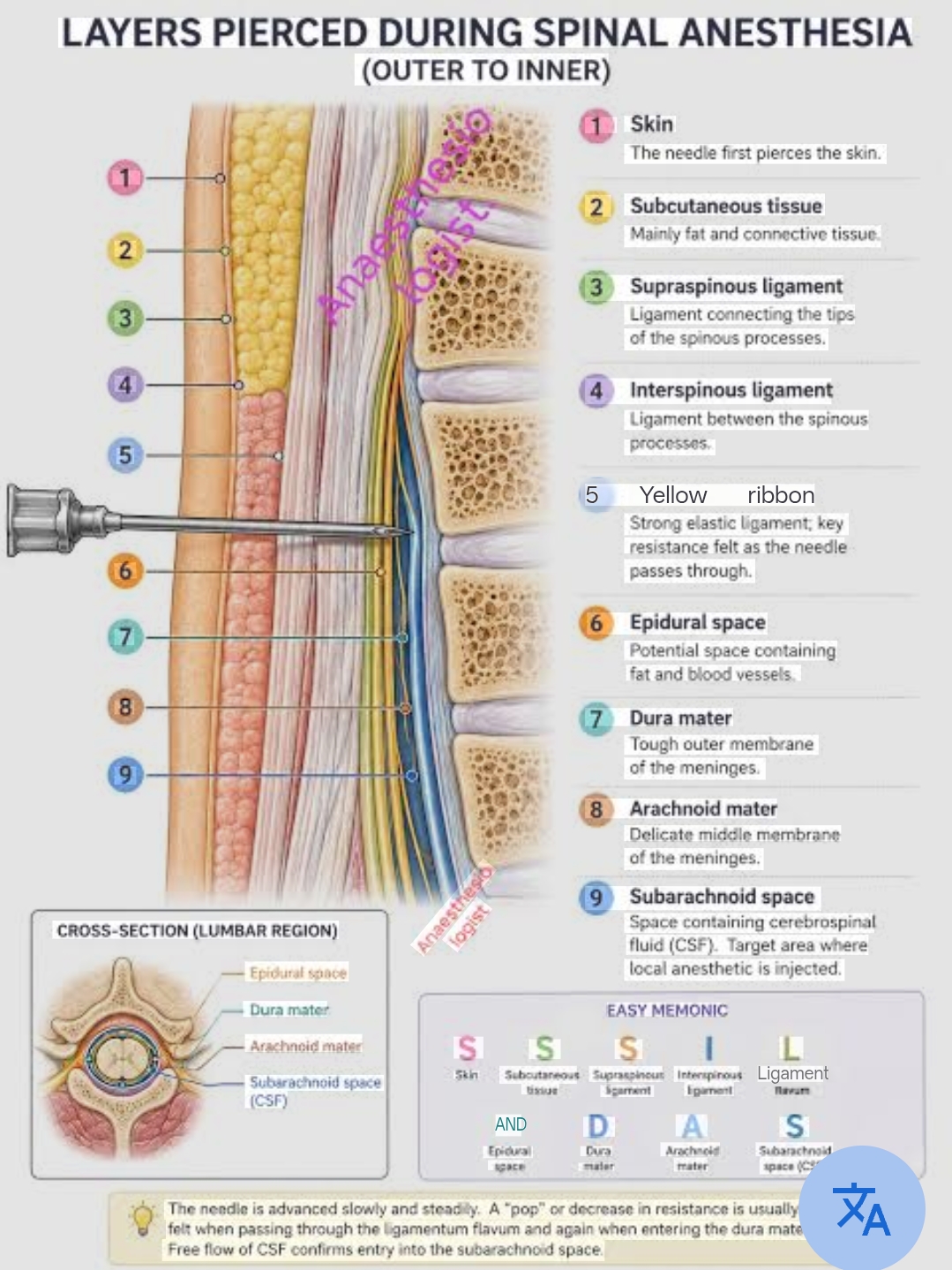
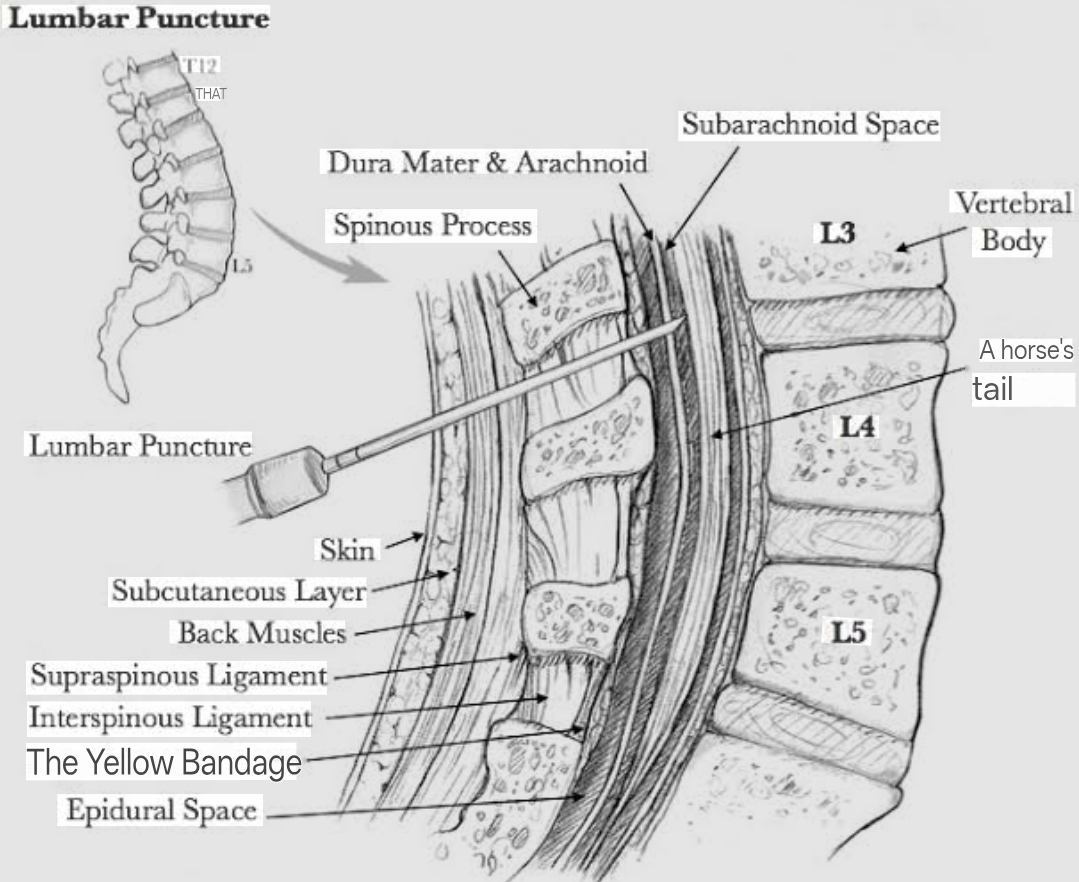
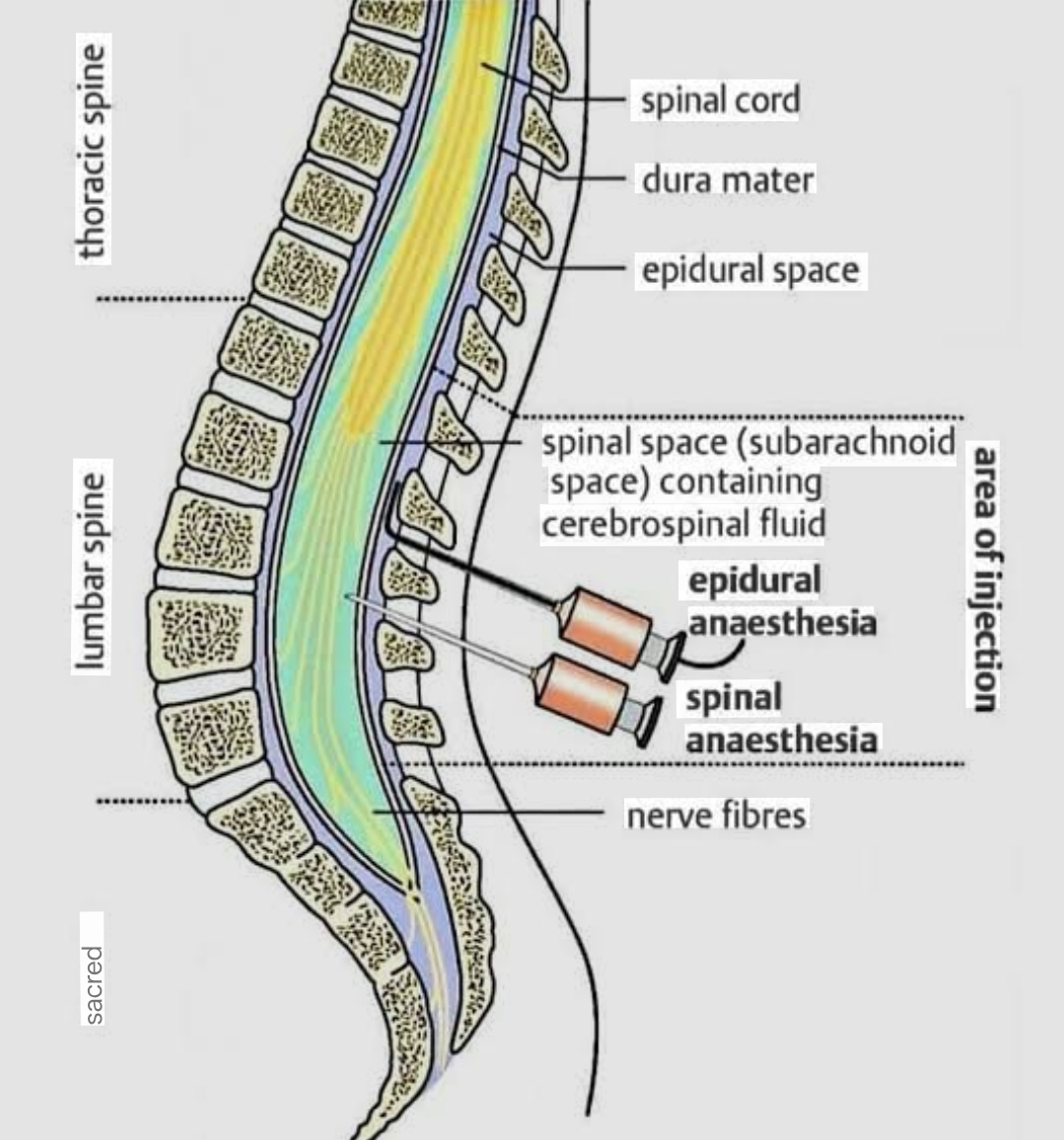
A. Anatomy of the Subarachnoid Space3 marks

  • Spinal cord (conus medullaris) ends at L1–L2 adults, L2–L3 children; cauda equina fills subarachnoid space below.
  • Meninges (inside→out): pia – subarachnoid space (CSF) – arachnoid – epidural space – dura. Dural sac extends to S2 adults (S3–S4 infants).
  • Surface landmark: Tuffier's line (iliac crests) crosses L4–L5 – safe puncture level (below conus).

B. Baricity & Factors Affecting Spread4 marks

FactorEffect
BaricityHyperbaric sinks (gravity-dependent); isobaric stays put; hypobaric rises
Position (most important)Supine after hyperbaric → thoracic curve T4–T6; sitting → saddle block
Dose↑dose → ↑block level and duration (more important than volume alone)
Patient heightTaller → lower block for same dose
AgeElderly → higher block for same dose (↓CSF volume)
Intra-abdominal pressure↑IAP (obesity, pregnancy, ascites) → ↑spread

C. Complications3 marks

ComplicationKey Point
Hypotension (30–60%)Sympathetic block; treat with tilt, ephedrine/phenylephrine, fluid
PDPH1–2% with 25G pencil-point; blood patch 85–90% effective
Total spinalRare, life-threatening; phrenic block → resp arrest; intubate + ventilate + vasopressors
Urinary retentionCommon – sacral parasympathetic block
TNS10–30% with lignocaine; resolves 72h
Cauda equina syndromeVery rare; microcatheters/hyperbaric 5% lignocaine – avoid
Examiner's PearlConus L1–L2 adults; Tuffier's line = L4–L5. Baricity: hyperbaric sinks (position dominant controller). Hyperbaric 0.5% bupivacaine most widely used. PDPH: 25G pencil-point ↓risk; blood patch 85–90% effective. Cauda equina: avoid microcatheters + hyperbaric 5% lignocaine.
References: Greene NM. Physiology of Spinal Anaesthesia, 4th Ed. Wildsmith JAW. Br J Anaesth 1986;58:692-700. Miller's Anaesthesia, 9th Ed.
"
lock Protected Clinical Document • Pulse App • Screenshots Strictly Prohibited
QUESTION 149 person Asked by .
bookmark_add

Non-Technical Skills in Anaesthesia — ANTS, CRM, Closed-Loop Communication &amp; ISBAR Define non-technical skills (NTS) and explain the ANTS framework as applied to anaesthetic practice [4]. Describe crew resource management (CRM) and the role of closed-loop communication in error prevention [3]. Outline ISBAR as a structured handover tool and the impact of cognitive biases on clinical decision-making [3].

description Clinical Response
" Q94 - Non-Technical Skills in Anaesthesia — ANTS, CRM, Closed-Loop Communication & ISBAR
Q94 · Paper II · 10 MARKS · Long Answer

Non-Technical Skills in Anaesthesia — ANTS, CRM, Closed-Loop Communication & ISBAR

Question: Define non-technical skills (NTS) and explain the ANTS framework as applied to anaesthetic practice [4]. Describe crew resource management (CRM) and the role of closed-loop communication in error prevention [3]. Outline ISBAR as a structured handover tool and the impact of cognitive biases on clinical decision-making [3].
Core ConceptNTS failures (communication breakdown, poor situational awareness, fixation errors) contribute to >70% of anaesthetic adverse events – equal to or greater than technical failures alone.

A. Non-Technical Skills & ANTS Framework4 marks

ANTS CategoryElements
1. Task ManagementPlanning & preparing; prioritising; maintaining standards; utilising resources
2. Situational AwarenessGathering information; recognising & understanding; anticipating (Level 3 SA = projection)
3. Decision MakingIdentifying options; balancing risks; re-evaluating
4. Team WorkingCoordinating; exchanging information; assertiveness; supporting others

B. CRM & Closed-Loop Communication3 marks

  • CRM origins: aviation (1970s–80s) after crashes traced to communication/hierarchy failures (Tenerife 1977); Helmreich (1999) translated CRM to medicine.
  • Core principles: shared mental model, speak-up culture, structured workload management, calm clear leadership.
  • Closed-loop communication: sender states message to named person → receiver reads back → sender confirms; prevents omission/commission errors, critical for drug dosing and crisis management.

C. ISBAR & Cognitive Biases3 marks

ISBARContent
IdentityWho is speaking/receiving, who is the patient
SituationWhat is happening now
BackgroundRelevant history, medications, allergies
AssessmentClinical assessment/diagnosis
RecommendationWhat needs to happen next

Cognitive biases: anchoring (over-reliance on first info), availability (recent events over-weighted), fixation error/premature closure (locking onto one diagnosis), framing effect, automation bias.

Examiner's PearlANTS = Task Management + Situational Awareness + Decision Making + Team Working. SA levels: perceive→understand→project; fixation error = SA failure. Closed-loop: name→message→read-back→confirm. ISBAR reduces handover failures. Top biases: anchoring, availability, fixation error, framing.
References: Flin R et al. Br J Anaesth 2003;90:580-588. Helmreich RL. BMJ 2000;320:781-785. RCOA/AAGBI NTSA Curriculum 2021. Gawande A. The Checklist Manifesto 2009.
"
lock Protected Clinical Document • Pulse App • Screenshots Strictly Prohibited
QUESTION 150 person Asked by .
bookmark_add

Continuous Renal Replacement Therapy (CRRT) in ICU — Modalities, Dose &amp; Anticoagulation Compare and contrast intermittent haemodialysis (IHD) with continuous renal replacement therapy (CRRT) modalities &ndash; CVVH, CVVHD, and CVVHDF [4]. Discuss the prescribed dose of CRRT, anticoagulation strategies (heparin vs citrate), and timing of initiation in AKI [4]. Outline specific indications for CRRT beyond AKI and describe circuit troubleshooting [2].

collections Question Diagrams & Reference Images (2)
Question Reference Diagram
zoom_in View Image
Question Reference Diagram
zoom_in View Image
description Clinical Response
" Q95 - Continuous Renal Replacement Therapy (CRRT) in ICU — Modalities, Dose & Anticoagulation
Q95 · Paper II · 10 MARKS · Long Answer

Continuous Renal Replacement Therapy (CRRT) in ICU — Modalities, Dose & Anticoagulation

Question: Compare and contrast intermittent haemodialysis (IHD) with continuous renal replacement therapy (CRRT) modalities – CVVH, CVVHD, and CVVHDF [4]. Discuss the prescribed dose of CRRT, anticoagulation strategies (heparin vs citrate), and timing of initiation in AKI [4]. Outline specific indications for CRRT beyond AKI and describe circuit troubleshooting [2].
Core ConceptCRRT is preferred in haemodynamically unstable critically ill patients – slow continuous removal avoids the rapid shifts of IHD. Dose should be 20–25 mL/kg/hr; higher confers no benefit (RENAL/ATN trials).

A. IHD vs CRRT Modalities4 marks

FeatureIHDCVVHCVVHDCVVHDF
MechanismDiffusionConvectionDiffusionBoth
Haemodynamic stabilityPoorExcellentExcellentExcellent
ICP effectUnfavourable (disequilibrium)FavourableFavourableFavourable
Preferred inStable/chronic RFUnstable ICU, raised ICPHigh diffusive needMost critically ill

B. Dose, Anticoagulation & Timing4 marks

  • Dose: prescribe 25–30 mL/kg/hr to deliver ~20–25 (RENAL & ATN trials: no mortality benefit above this).
  • Citrate anticoagulation (preferred, KDIGO): chelates ionised Ca²⁺ in circuit; superior filter life, less bleeding than heparin; CI in severe liver failure (citrate accumulation).
  • Heparin: cheap, reversible, but systemic bleeding/HIT risk.
  • Timing (STARRT-AKI 2020): accelerated vs standard initiation – no mortality difference; avoid over-starting (impairs renal recovery). Absolute indications: refractory K⁺>6.5, pH<7.15, refractory pulmonary oedema, uraemic complications.

C. Non-AKI Indications & Troubleshooting2 marks

  • Non-AKI: refractory fluid overload, cytokine removal in sepsis (limited evidence), acute liver failure (MARS), rhabdomyolysis (myoglobin clearance), drug overdose (lithium, salicylates, metformin).
  • Troubleshooting: access pressure alarm → kinked catheter; high TMP → filter clotting; blood leak → membrane breach; citrate accumulation → total:ionised Ca ratio >2.5 → reduce citrate.
Examiner's PearlCVVH=convection; CVVHD=diffusion; CVVHDF=both. CRRT preferred: unstable, raised ICP, liver failure. Dose 20–25 mL/kg/hr delivered (RENAL/ATN: no benefit above this). Citrate preferred (KDIGO) except severe liver failure. STARRT-AKI: no mortality benefit to early initiation.
References: Bellomo R et al. NEJM 2009;361:1627-1638. VA/NIH ATN study. NEJM 2008;359:7-20. KDIGO AKI Guideline 2012. STARRT-AKI. NEJM 2020;383:240-251.
"

Showing 141150 of 337 questions

account_tree

Subcategory Tree

Explore Anesthesia subcategories

folder_special Anesthesia
Main
lock

Category Subscription

Subscribe to Anesthesia to unlock this module and all nested subcategories.

  • check_circle Access Anesthesia & all subcategories
  • check_circle Detailed, Peer-Reviewed Answers
  • check_circle High-yield visual aids & imaging
Get Category Subscription arrow_forward
Secure 256-bit SSL Connection

Anatomical Models

Explore high-fidelity 3D visualizations included in premium modules.

Case Reviews

Real-world clinical scenarios narrated by senior consultants.

Pulse App